



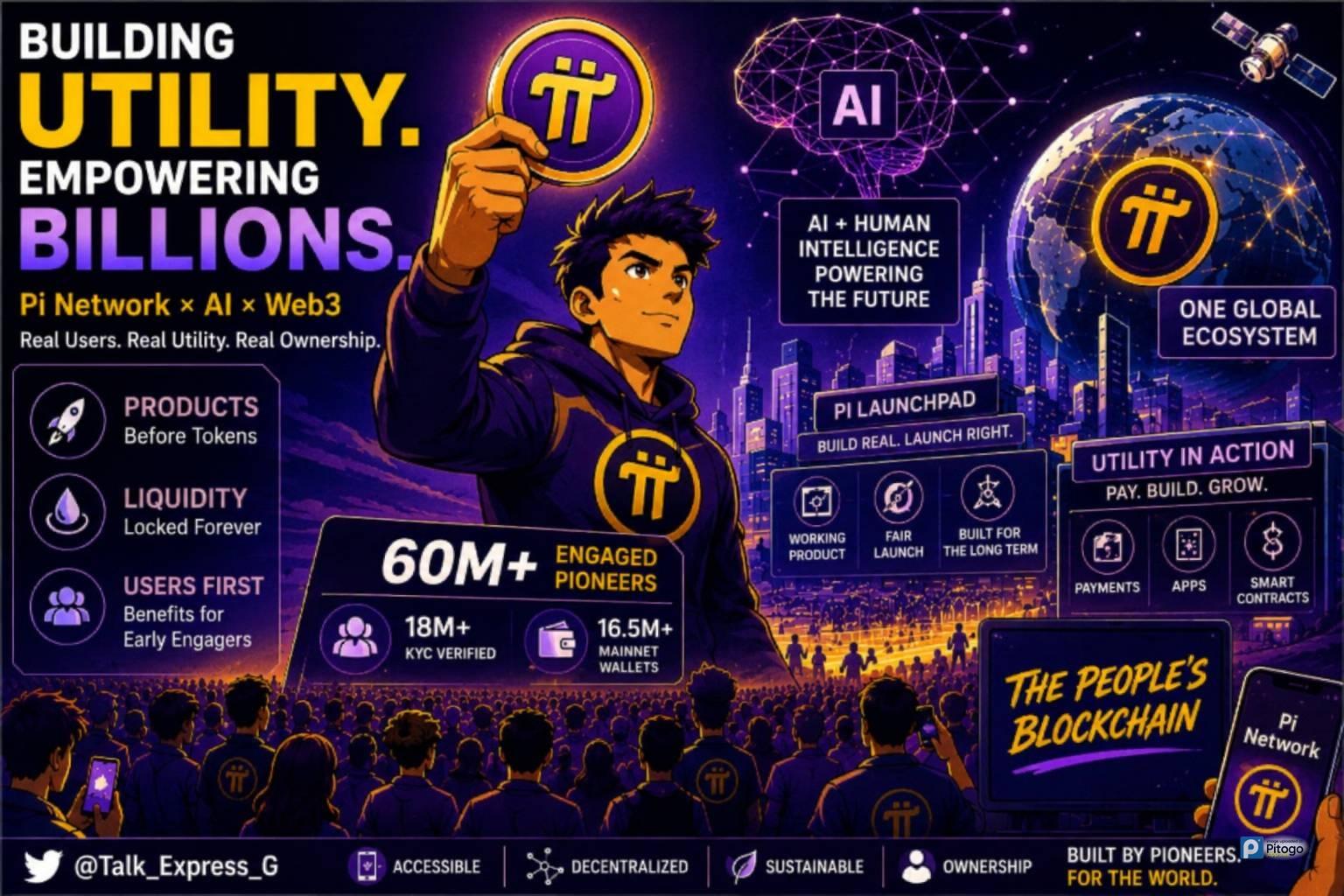
<p>Pi Network’s Utility-First Vision: Web3, AI, and Real-World Adoption</p><p><br></p><p>At Consensus 2026 Miami, Dr. Chengdiao Fan discussed a major problem in crypto: many projects focus more on token speculation and fundraising than building real products. According to her, this creates short-term hype but very little long-term utility.</p><p><br></p><p>Pi Network aims to take a different approach by connecting blockchain tools directly with real-world usage. Instead of launching tokens first and worrying about utility later, Pi focuses on building an ecosystem where payments, apps, smart contracts, and digital ownership work together inside a functioning product economy.</p><p><br></p><p>One of the biggest highlights was the Pi Launchpad model. Unlike traditional token launches where teams can quickly sell tokens and extract liquidity, Pi’s proposed system pushes launch proceeds permanently into liquidity pools instead of directly to project founders. Projects are also expected to have working products before launch, and early users of those products may receive benefits or preferred access.</p><p><br></p><p>The idea is simple: tokens should support utility and user growth, not just speculation.</p><p><br></p><p>Dr. Fan also highlighted Pi Network’s scale advantage. According to the session, the ecosystem has over 60 million engaged users, around 18 million KYC-verified users, and over 16 million migrated mainnet wallets. This creates one of the world’s largest verified blockchain communities.</p><p><br></p><p>In the AI era, this becomes even more important. As AI tools make app development easier, the real competitive advantage shifts toward trusted users, authentic engagement, human participation, and network effects. Pi positions itself as infrastructure for that future by combining blockchain with verified human identity and participation.</p><p><br></p><p>Pi’s mobile-first approach also makes crypto more accessible. Unlike traditional mining systems requiring expensive hardware and electricity, Pi allows participation through smartphones, lowering barriers for billions of people worldwide—especially in emerging markets.</p><p><br></p><p>Supporters believe Pi’s long-term strength comes from:</p><p><br></p><p>- large-scale adoption,</p><p>- verified identities,</p><p>- mobile accessibility,</p><p>- ecosystem utility,</p><p>- and AI-era relevance.</p><p><br></p><p>However, challenges remain. Real success depends on whether the ecosystem can convert millions of users into active participants through useful applications, payments, businesses, and real economic activity.</p><p><br></p><p>Pi still faces skepticism, volatility, and execution pressure. But unlike many hype-driven crypto projects, it has already built a working blockchain, non-custodial wallets, KYC infrastructure, developer tools, and a growing application ecosystem.</p><p><br></p><p>If Pi successfully turns its massive user base into an active utility-driven economy, its network effects could become self-reinforcing:</p><p>more users → more apps → more utility → more adoption.</p><p><br></p><p>The future of blockchain may not belong only to the fastest technology, but to ecosystems that successfully combine utility, accessibility, ownership, and real human participation at global scale.</p>
<p>Pi Network’s Utility-First Vision: Web3, AI, and Real-World Adoption</p><p><br></p><p>At Consensus 2026 Miami, Dr. Chengdiao Fan discussed a major problem in crypto: many projects focus more on token speculation and fundraising than building real products. According to her, this creates short-term hype but very little long-term utility.</p><p><br></p><p>Pi Network aims to take a different approach by connecting blockchain tools directly with real-world usage. Instead of launching tokens first and worrying about utility later, Pi focuses on building an ecosystem where payments, apps, smart contracts, and digital ownership work together inside a functioning product economy.</p><p><br></p><p>One of the biggest highlights was the Pi Launchpad model. Unlike traditional token launches where teams can quickly sell tokens and extract liquidity, Pi’s proposed system pushes launch proceeds permanently into liquidity pools instead of directly to project founders. Projects are also expected to have working products before launch, and early users of those products may receive benefits or preferred access.</p><p><br></p><p>The idea is simple: tokens should support utility and user growth, not just speculation.</p><p><br></p><p>Dr. Fan also highlighted Pi Network’s scale advantage. According to the session, the ecosystem has over 60 million engaged users, around 18 million KYC-verified users, and over 16 million migrated mainnet wallets. This creates one of the world’s largest verified blockchain communities.</p><p><br></p><p>In the AI era, this becomes even more important. As AI tools make app development easier, the real competitive advantage shifts toward trusted users, authentic engagement, human participation, and network effects. Pi positions itself as infrastructure for that future by combining blockchain with verified human identity and participation.</p><p><br></p><p>Pi’s mobile-first approach also makes crypto more accessible. Unlike traditional mining systems requiring expensive hardware and electricity, Pi allows participation through smartphones, lowering barriers for billions of people worldwide—especially in emerging markets.</p><p><br></p><p>Supporters believe Pi’s long-term strength comes from:</p><p><br></p><p>- large-scale adoption,</p><p>- verified identities,</p><p>- mobile accessibility,</p><p>- ecosystem utility,</p><p>- and AI-era relevance.</p><p><br></p><p>However, challenges remain. Real success depends on whether the ecosystem can convert millions of users into active participants through useful applications, payments, businesses, and real economic activity.</p><p><br></p><p>Pi still faces skepticism, volatility, and execution pressure. But unlike many hype-driven crypto projects, it has already built a working blockchain, non-custodial wallets, KYC infrastructure, developer tools, and a growing application ecosystem.</p><p><br></p><p>If Pi successfully turns its massive user base into an active utility-driven economy, its network effects could become self-reinforcing:</p><p>more users → more apps → more utility → more adoption.</p><p><br></p><p>The future of blockchain may not belong only to the fastest technology, but to ecosystems that successfully combine utility, accessibility, ownership, and real human participation at global scale.</p>
0 Commentaires
0 Parts
39 Vue
0 Aperçu





 Chinese
 English
 Arabic
 Spanish
 Portuguese
 Deutsch
 Turkish
 Dutch
Dutch
 Italiano
 Russian
 Romanian
 Portuguese (Brazil)
 Greek
Greek